
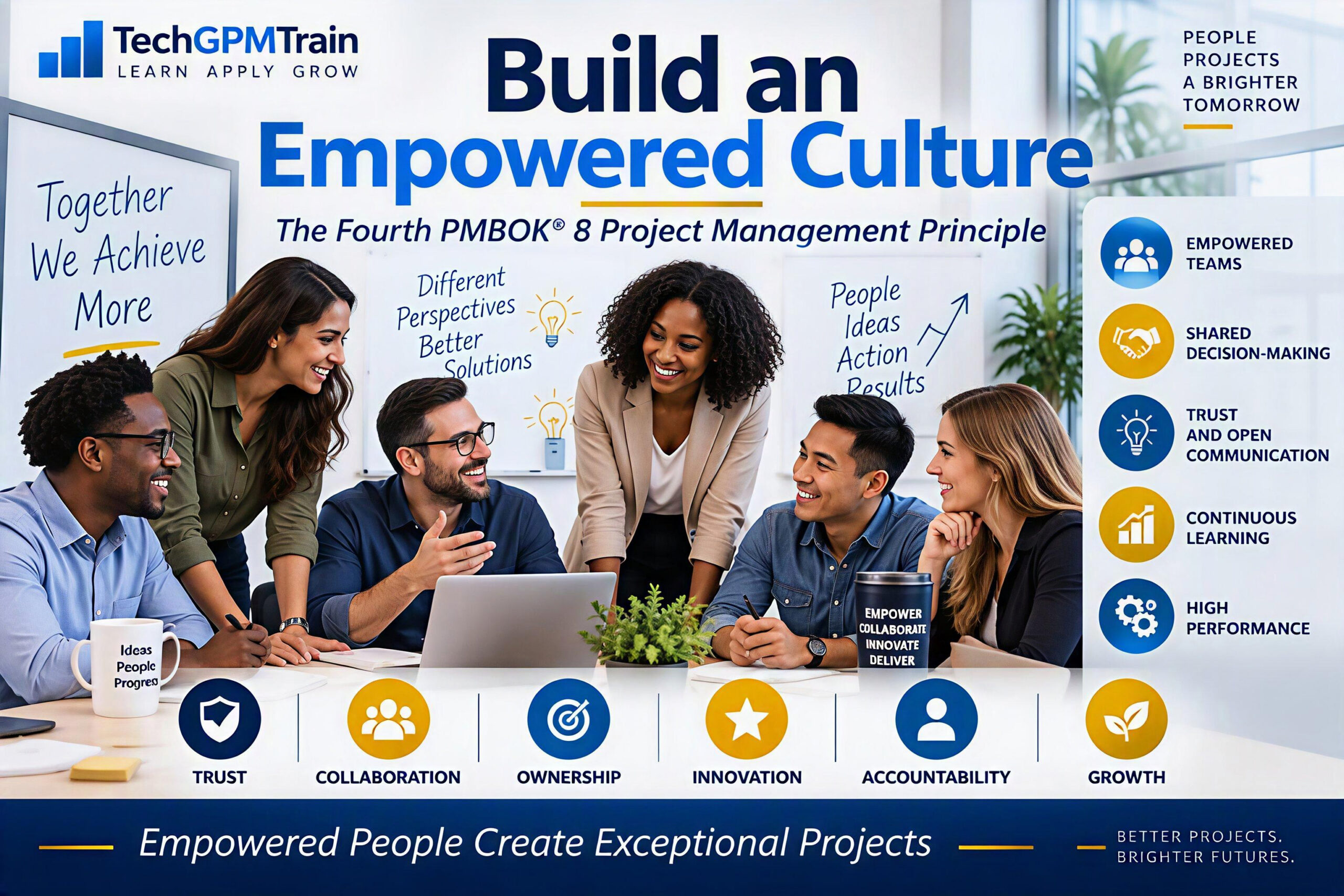
PMBOK® 8 Principle #4: Build an Empowered Culture
PMBOK® 8 Principle #4: Build an Empowered Culture
The most successful projects are rarely the result of one individual. They are the product of talented teams working together toward a common goal.
Recognizing the importance of people in project success, PMBOK® 8 identifies the fourth Project Management Principle as:
Build an Empowered Culture.
An empowered culture enables individuals and teams to take ownership of their work, make informed decisions, collaborate effectively, and contribute their unique strengths to project success. Rather than controlling every action, effective project leaders create an environment where people can thrive.
What Is an Empowered Culture?
An empowered culture is a work environment where team members are trusted, supported, and encouraged to contribute to project outcomes.
Empowerment involves more than simply assigning work. It includes providing the authority, information, resources, and confidence that people need to perform at their best.
In empowered teams, individuals:
- Take ownership of outcomes
- Contribute ideas and solutions
- Collaborate openly
- Make decisions within their areas of responsibility
- Support one another’s success
- Continuously learn and improve
Empowerment transforms teams from task executors into active contributors to organizational goals.
Why Empowerment Matters
Modern projects operate in environments that are increasingly complex, dynamic, and fast-paced.
Project managers cannot personally solve every problem or make every decision.
Empowered teams provide several advantages:
- Faster decision-making
- Increased innovation
- Higher productivity
- Improved employee engagement
- Better stakeholder outcomes
- Greater adaptability to change
When people feel trusted and valued, they are more likely to invest their energy and creativity into achieving project objectives.
The Foundation of Empowerment: Trust
Empowerment cannot exist without trust.
Project leaders must trust team members to perform their responsibilities, while team members must trust leadership to provide guidance, support, and transparency.
Trust is built through:
- Open communication
- Consistent leadership
- Ethical behavior
- Accountability
- Respect for diverse viewpoints
Without trust, teams become hesitant, disengaged, and overly dependent on management direction.
Characteristics of an Empowered Culture
Shared Ownership
Successful teams understand how their work contributes to overall project objectives.
Instead of focusing only on individual tasks, team members take ownership of project outcomes.
Collaboration
Empowered cultures encourage collaboration across departments, functions, and stakeholder groups.
Individuals are encouraged to share ideas, raise concerns, and solve problems together.
Psychological Safety
Team members should feel comfortable expressing opinions, asking questions, and identifying risks without fear of blame or criticism.
Innovation flourishes when people feel safe to speak openly.
Continuous Learning
Empowered teams embrace feedback, lessons learned, and professional development opportunities.
Learning becomes part of the project culture rather than an occasional activity.
Recognition and Appreciation
Acknowledging contributions helps reinforce positive behaviors and motivates continued excellence.
How Project Leaders Build an Empowered Culture
Establish Clear Expectations
People perform best when they understand:
- Project goals
- Individual responsibilities
- Success criteria
- Decision-making authority
Clarity creates confidence.
Delegate Authority
Empowerment requires leaders to delegate appropriate authority rather than retaining control of every decision.
Delegation demonstrates trust and develops future leaders.
Encourage Collaboration
Create opportunities for team members to participate in planning, problem-solving, and decision-making activities.
Collaboration often leads to stronger solutions and increased engagement.
Provide Resources and Support
Empowered teams still require leadership support.
Project managers should remove obstacles, provide necessary resources, and help teams succeed.
Recognize Contributions
Celebrate achievements and acknowledge team successes when milestones are reached.
Recognition strengthens morale and reinforces positive performance.
Common Barriers to Empowerment
Not every organization naturally supports empowerment.
Common obstacles include:
- Micromanagement
- Lack of trust
- Poor communication
- Fear of failure
- Unclear roles and responsibilities
- Resistance to change
Project leaders can help overcome these barriers by fostering transparency, accountability, and open communication.
PMP® Exam Perspective
PMI frequently favors leadership approaches that support team empowerment.
On the PMP exam, the best answers often involve:
- Coaching rather than directing
- Collaboration rather than command-and-control management
- Facilitating team decision-making
- Removing impediments
- Encouraging stakeholder engagement
- Supporting servant leadership
Candidates should remember that PMI values empowered teams over excessive managerial control.
Signs of an Empowered Project Team
Projects with empowered cultures often exhibit:
✅ High levels of collaboration
✅ Strong team engagement
✅ Shared accountability
✅ Open communication
✅ Innovative problem-solving
✅ Faster decision-making
✅ Continuous learning and improvement
✅ Strong stakeholder relationships
These indicators often contribute directly to better project outcomes.
Real-World Example
Imagine a project manager overseeing the implementation of a new enterprise software system.
In a traditional command-and-control environment, all decisions must be approved through management.
In an empowered culture, technical experts are trusted to recommend solutions, identify risks, and resolve issues within established guidelines.
As a result:
- Decisions occur faster
- Problems are resolved sooner
- Team morale improves
- Innovation increases
- Project objectives are achieved more efficiently
Empowerment enables organizations to fully leverage the expertise of their teams.
Final Thoughts
The PMBOK® 8 principle of Build an Empowered Culture reminds project leaders that success is ultimately achieved through people.
When team members are trusted, supported, and empowered to contribute their best work, organizations gain more than project results. They develop stronger teams, future leaders, and a culture of continuous improvement.
Empowered people create empowered teams.
Empowered teams create successful projects.
Call to Action
Preparing for the PMP® Exam or looking to strengthen your leadership skills? Follow TechGPMTrain for practical insights into PMBOK® 8 principles, project leadership strategies, and PMP exam success techniques.
Access the full course:
Now available:
#PMBOK8 #ProjectManagement #PMPExam #PMPPreparation #EmpoweredCulture #EmpoweredTeams #ProjectLeadership #ServantLeadership #TeamDevelopment #Collaboration #HighPerformingTeams #PMI #TechGPMTrain


