

PMBOK® 8 Principle #6: Enable Quality Through Processes and Outcomes
PMBOK® 8 Principle #6: Enable Quality Through Processes and Outcomes
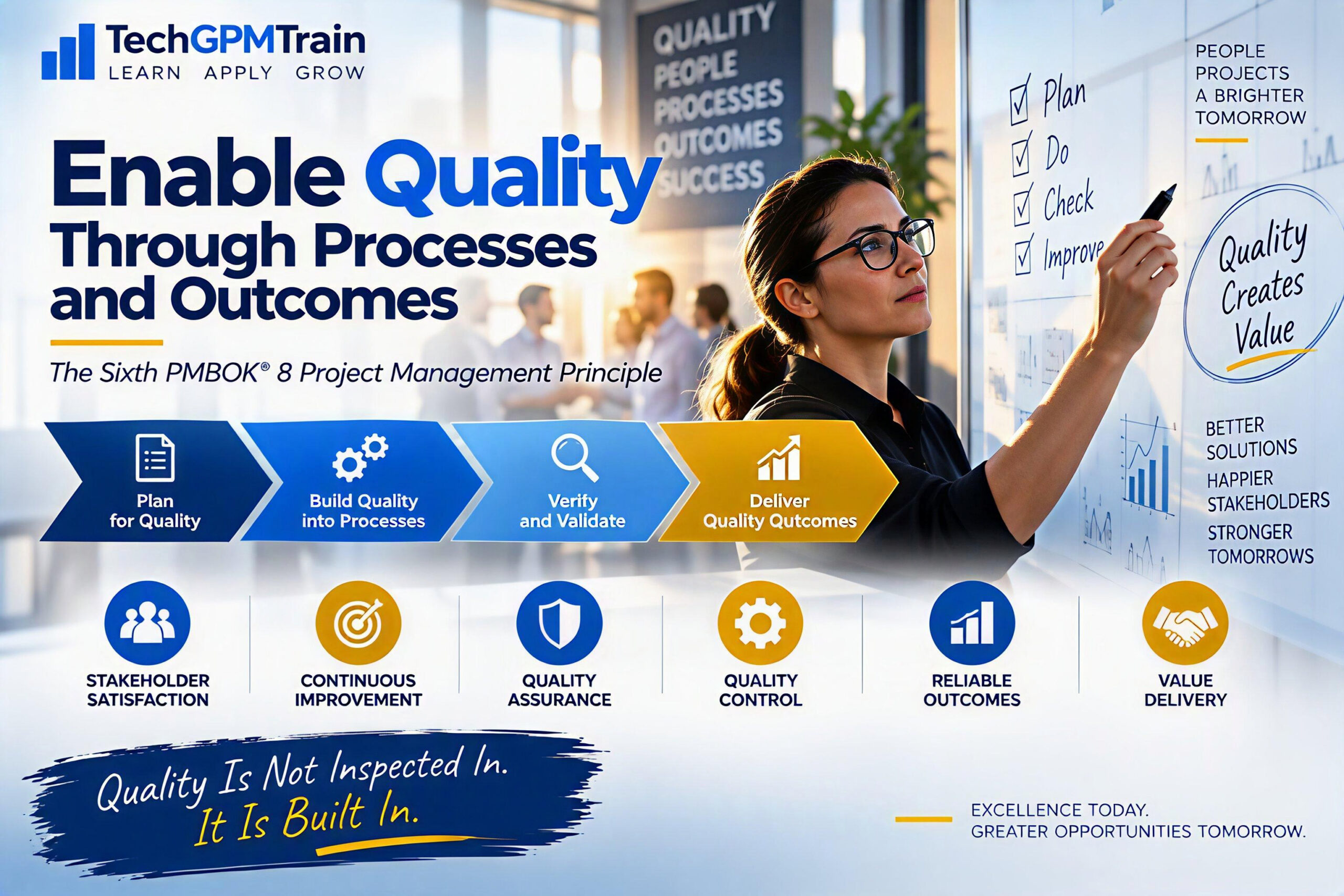
Delivering a project on time and within budget is important, but those achievements alone do not guarantee success. If the final product fails to meet expectations, satisfy customers, or perform as intended, the project cannot be considered truly successful.
This reality is reflected in the sixth PMBOK® 8 Project Management Principle:
Enable Quality Through Processes and Outcomes.
Quality is not something added at the end of a project. It is built into the way projects are planned, managed, executed, monitored, and delivered. Successful project leaders create a culture where quality becomes everyone’s responsibility.
What Does Quality Mean in Project Management?
Quality refers to the degree to which a product, service, or result fulfills requirements and satisfies stakeholder expectations.
Quality is achieved when deliverables:
- Meet agreed requirements
- Perform as intended
- Provide value to stakeholders
- Comply with applicable standards
- Are reliable and sustainable
- Support organizational objectives
Quality is not necessarily about producing the most expensive or complex solution.
Instead, quality means delivering the right solution that effectively fulfills its intended purpose.
Why Quality Matters
Poor quality can have significant consequences.
Projects that neglect quality often experience:
- Cost overruns
- Rework
- Delays
- Customer dissatisfaction
- Increased risks
- Damaged reputation
- Lost business opportunities
High-quality projects, on the other hand, build trust and create long-term value.
Organizations known for quality often enjoy:
- Higher customer loyalty
- Improved stakeholder confidence
- Better operational performance
- Reduced waste
- Greater efficiency
- Stronger competitive advantage
Quality is an investment that continues generating benefits long after project completion.
Quality Is More Than Testing
One common misconception is that quality can be achieved through inspections or testing alone.
Testing is important, but quality begins much earlier.
PMBOK® 8 encourages project teams to design quality into both:
Processes
The methods used to perform project work.
Examples include:
- Standardized procedures
- Risk management practices
- Effective communication
- Peer reviews
- Continuous improvement activities
Outcomes
The final deliverables and business results produced by the project.
Examples include:
- Reliable products
- Effective services
- Satisfied stakeholders
- Achieved business objectives
True quality requires attention to both.
Quality Assurance vs. Quality Control
PMP® candidates should understand the difference between these two concepts.
Quality Assurance (QA)
Quality Assurance focuses on preventing defects.
Examples include:
- Process reviews
- Standards compliance
- Training programs
- Process improvements
- Best-practice implementation
QA is proactive.
Quality Control (QC)
Quality Control focuses on identifying defects.
Examples include:
- Testing
- Inspections
- Audits
- Product verification
- Performance evaluations
QC is reactive.
Both are essential components of successful quality management.
Characteristics of Quality-Focused Project Leaders
Customer-Centric Thinking
Quality leaders focus on the needs and expectations of stakeholders throughout the project lifecycle.
Continuous Improvement
Successful teams look for ways to improve processes, products, and performance on an ongoing basis.
Attention to Detail
Small quality issues can become major problems later.
Quality leaders address concerns before they grow.
Accountability
Quality is everyone’s responsibility, not just the responsibility of a quality department.
Data-Driven Decisions
High-performing teams use metrics and performance data to evaluate quality and guide improvement efforts.
Practical Ways to Enable Quality
Establish Clear Requirements
Quality begins with understanding what stakeholders expect.
Unclear requirements often create quality problems later.
Build Quality Into Planning
Include quality objectives, standards, verification activities, and acceptance criteria during project planning.
Encourage Peer Reviews
Peer reviews help identify issues early when they are less costly to address.
Measure Performance
Monitor metrics that indicate quality performance.
Examples include:
- Defect rates
- Customer satisfaction
- Rework percentages
- Process efficiency
- Product reliability
Promote Continuous Improvement
Use lessons learned and retrospective reviews to improve project delivery and outcomes.
The Relationship Between Quality and Value
Earlier in this PMBOK® 8 series, we explored the principle of focusing on value.
Quality and value are closely connected.
Without quality:
- Deliverables may fail
- Customers may become dissatisfied
- Organizational goals may not be achieved
Quality enables value realization.
The highest-value projects typically combine:
- Strong leadership
- Stakeholder engagement
- Sustainable practices
- Effective change management
- Empowered teams
- Quality-focused delivery
Together, these principles create lasting organizational success.
PMP® Exam Perspective
On the PMP exam, PMI frequently favors actions that:
- Prevent defects rather than correcting them later
- Promote continuous improvement
- Focus on stakeholder expectations
- Encourage quality planning
- Support effective processes
- Use data to guide decisions
Candidates should remember that PMI often emphasizes proactive quality management over reactive problem-solving.
Signs of a High-Quality Project
Projects that successfully enable quality often demonstrate:
✅ Clear requirements
✅ Stakeholder satisfaction
✅ Low defect rates
✅ Effective communication
✅ Continuous improvement
✅ Strong process discipline
✅ Reliable deliverables
✅ Measurable business benefits
These indicators suggest quality has been integrated throughout the project lifecycle rather than treated as a final checkpoint.
Real-World Example
Imagine a project team developing a customer-facing mobile application.
A team focused only on deadlines may rush development and perform limited testing before release.
A quality-focused team incorporates:
- Frequent reviews
- User feedback
- Automated testing
- Risk assessments
- Performance monitoring
While the second approach may require additional effort during development, it significantly reduces costly defects after deployment and improves customer satisfaction.
The result is a better product, improved stakeholder confidence, and greater business value.
Final Thoughts
The PMBOK® 8 principle of Enable Quality Through Processes and Outcomes reinforces an important truth:
Quality is not an event.
Quality is a mindset.
Successful project leaders build quality into every aspect of project work, from planning and execution to delivery and continuous improvement.
When quality becomes part of the culture, projects produce better products, stronger stakeholder relationships, and more sustainable business results.
Excellence is rarely accidental.
It is the result of consistent attention to quality.
Call to Action
Preparing for the PMP® Exam or growing your project leadership skills? Follow TechGPMTrain for practical insights, PMBOK® 8 guidance, exam preparation strategies, and real-world project management techniques that help you learn, apply, and grow.
Previous Articles in the Series
✅ PMBOK® 8 Principle #1: Be an Accountable Leader
✅ PMBOK® 8 Principle #2: Focus on Value
✅ PMBOK® 8 Principle #3: Integrate Sustainability Throughout the Project
✅ PMBOK® 8 Principle #4: Build an Empowered Culture
✅ PMBOK® 8 Principle #5: Lead Through Change
✅ PMBOK® 8 Principle #6: Enable Quality Through Processes and Outcomes
#PMBOK8 #ProjectManagement #PMPExam #PMPPreparation #QualityManagement #QualityAssurance #QualityControl #ContinuousImprovement #ProjectLeadership #PMI #ProjectExcellence #StakeholderSatisfaction #TechGPMTrain
This completes the six-article PMBOK® 8 Principles series.
Access the full course:
Now available:


