
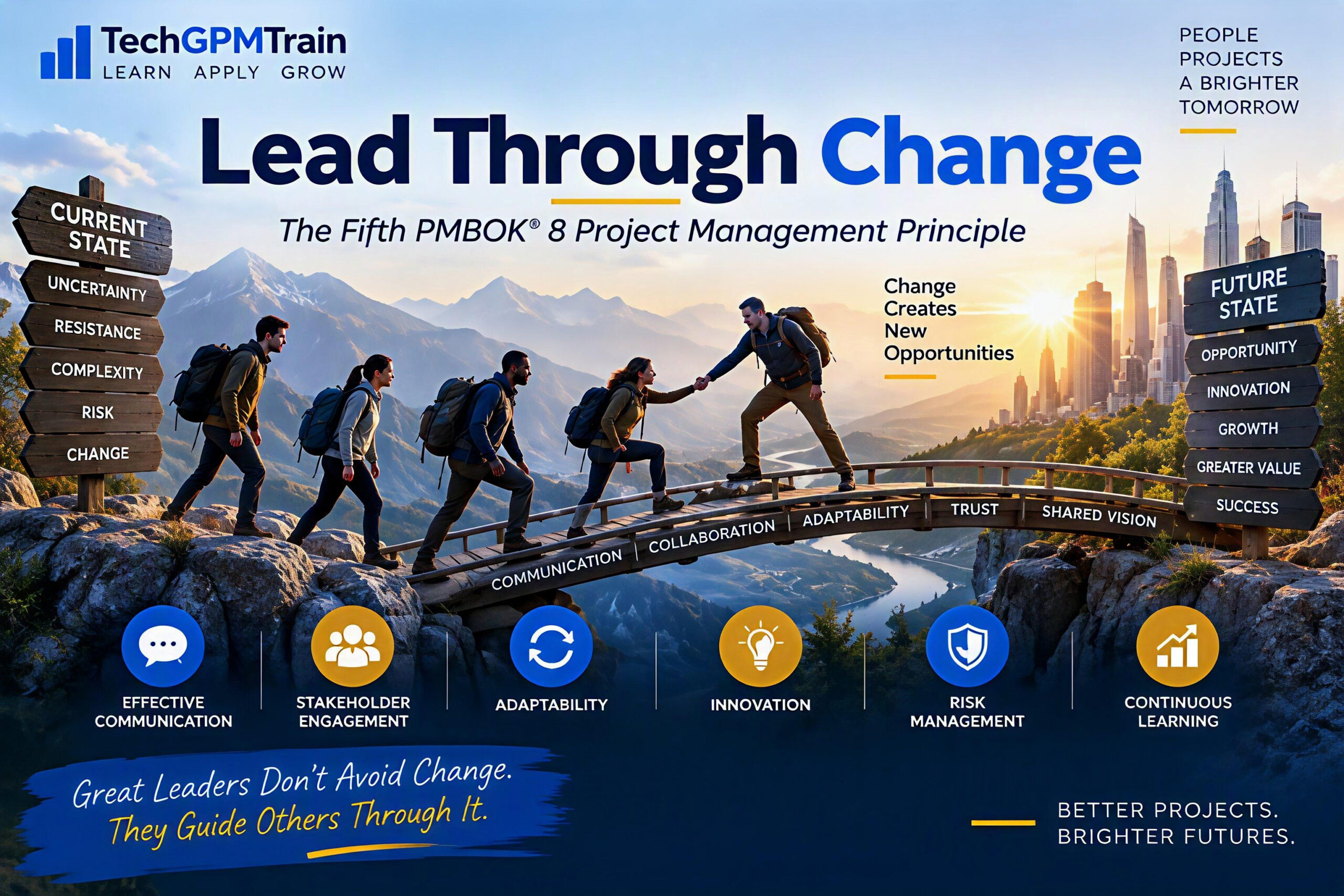
PMBOK® 8 Principle #5: Lead Through Change
PMBOK® 8 Principle #5: Lead Through Change
Change is inevitable in project management.
Requirements evolve. Priorities shift. New technologies emerge. Stakeholder expectations change. Market conditions fluctuate. The most successful project managers recognize that change is not an obstacle to overcome. It is a reality to embrace.
This is the foundation of the fifth PMBOK® 8 Project Management Principle:
Lead Through Change.
Rather than resisting change, effective project leaders guide teams through uncertainty, helping stakeholders adapt while maintaining focus on project objectives and value delivery.
Why Change Is Unavoidable
Every project exists within a dynamic environment.
Organizations experience:
- New business priorities
- Competitive pressures
- Technological advances
- Regulatory changes
- Resource constraints
- Customer expectation shifts
As these factors evolve, projects must evolve as well.
Project managers who expect plans to remain unchanged often struggle. Those who anticipate and manage change proactively are far more likely to achieve successful outcomes.
What Does It Mean to Lead Through Change?
Leading through change means helping individuals, teams, and organizations navigate uncertainty while maintaining progress toward project goals.
Successful leaders do not simply process change requests.
They:
- Communicate effectively
- Build trust
- Reduce uncertainty
- Encourage adaptability
- Support stakeholders
- Align teams around a shared vision
The goal is not merely to survive change.
The goal is to use change as an opportunity for growth and improvement.
Change Versus Change Management
While closely related, these concepts are not identical.
Change
A modification to project scope, schedule, resources, technology, processes, or organizational priorities.
Change Management
The structured approach used to help people understand, accept, and adapt to those changes.
PMI emphasizes that project success depends not only on managing technical changes but also on helping people navigate them successfully.
Why People Resist Change
Resistance is a natural response to uncertainty.
Individuals may resist change because of:
- Fear of the unknown
- Concerns about job impact
- Lack of understanding
- Insufficient communication
- Previous negative experiences
- Perceived loss of control
Effective project leaders recognize resistance as valuable feedback rather than opposition.
Understanding the source of concerns often leads to better solutions and stronger stakeholder engagement.
Characteristics of Leaders Who Navigate Change Successfully
Adaptability
Effective leaders remain flexible when conditions evolve.
They adjust strategies without losing sight of project objectives.
Communication
Clear communication helps reduce uncertainty and build confidence.
Stakeholders need to understand:
- Why change is happening
- What is changing
- How it affects them
- What actions are required
Resilience
Projects encounter setbacks.
Strong leaders maintain focus and encourage teams to keep moving forward despite challenges.
Empathy
Change affects people differently.
Successful leaders listen carefully and address stakeholder concerns respectfully and professionally.
Vision
People are more likely to support change when they understand the desired outcome.
Leaders help stakeholders see the benefits and purpose behind transformation initiatives.
Practical Ways to Lead Through Change
Communicate Early and Often
Frequent communication reduces uncertainty and strengthens trust.
Provide updates even when all answers are not yet available.
Involve Stakeholders
Stakeholder engagement increases ownership and reduces resistance.
People are more likely to support decisions they help shape.
Address Concerns Directly
Avoid dismissing concerns or frustrations.
Listen carefully and respond with transparency.
Focus on Benefits
Help stakeholders understand how changes support organizational goals, project success, and long-term value.
Encourage Continuous Learning
Change often introduces new tools, processes, or ways of working.
Training and knowledge sharing help teams adapt successfully.
Change and Agile Thinking
The principle of leading through change aligns closely with Agile and adaptive approaches.
Agile teams recognize that:
- Requirements evolve
- Customer needs change
- Feedback improves outcomes
- Continuous adaptation creates value
Rather than fighting change, Agile frameworks encourage teams to embrace learning and adjust accordingly.
This mindset supports one of PMI’s most important themes: delivering value in changing environments.
PMP® Exam Perspective
On the PMP® exam, PMI frequently favors responses that demonstrate:
- Stakeholder engagement
- Active communication
- Collaboration
- Adaptability
- Root-cause analysis
- Servant leadership
Candidates should be cautious of answer choices that immediately escalate issues or impose solutions without first understanding stakeholder concerns.
In many scenarios, the best first step is communication and engagement.
Signs That Change Is Being Managed Successfully
Projects that successfully navigate change often demonstrate:
✅ Strong stakeholder engagement
✅ Clear communication
✅ Team adaptability
✅ Reduced resistance
✅ Continuous learning
✅ Effective risk management
✅ Sustained value delivery
✅ Organizational alignment
These indicators show that project leaders are helping teams move forward instead of becoming stalled by uncertainty.
Real-World Example
Imagine an organization implementing a new enterprise software platform.
Halfway through the project, new regulatory requirements emerge that require significant design modifications.
A project manager focused solely on the original plan may resist adjustments and create conflict.
A project leader who embraces change will:
- Evaluate impacts
- Engage stakeholders
- Communicate transparently
- Reassess priorities
- Update plans
- Guide the team through the transition
The result is a project that remains aligned with business and regulatory needs despite changing conditions.
Final Thoughts
The PMBOK® 8 principle of Lead Through Change recognizes that uncertainty is not a temporary condition in project management. It is a constant reality.
Project leaders who successfully navigate change build trust, promote adaptability, and help teams remain focused on delivering value regardless of shifting circumstances.
Projects rarely succeed because nothing changes.
Projects succeed because leaders help people adapt when change occurs.
Call to Action
Preparing for the PMP® Exam or strengthening your project leadership skills? Follow TechGPMTrain for practical guidance on PMBOK® 8 principles, leadership strategies, and real-world project management techniques that help you learn, apply, and grow.
Next in the Series
PMBOK® 8 Principle #6: Enable Quality Through Processes and Outcomes
Access the full course:
Now available:
#PMBOK8 #ProjectManagement #PMPExam #PMPPreparation #LeadThroughChange #ChangeManagement #ProjectLeadership #AdaptiveLeadership #OrganizationalChange #AgileMindset #StakeholderManagement #PMI #TechGPMTrain


