
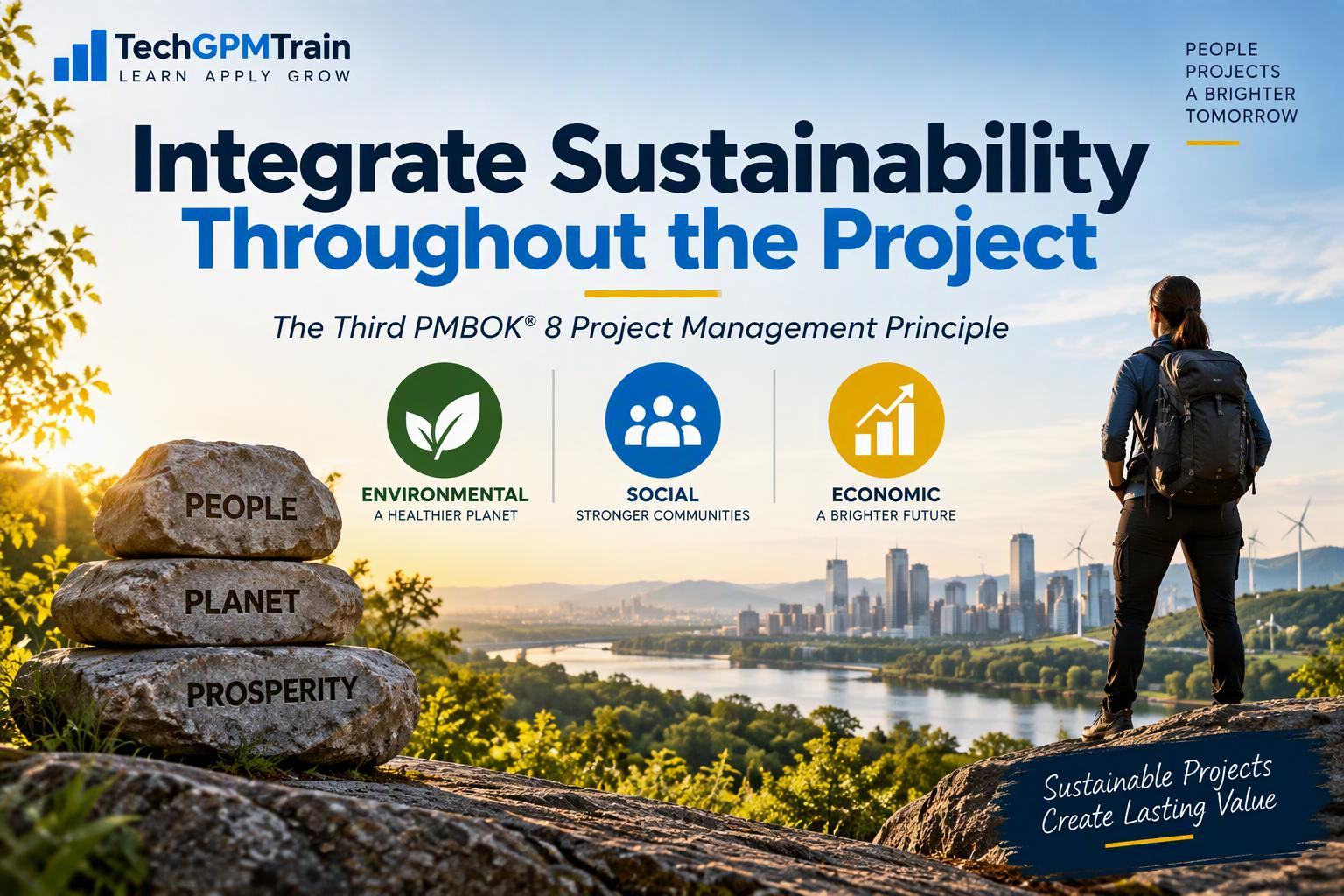
PMBOK® 8 Principle #3: Integrate Sustainability Throughout the Project
Project managers are often under pressure to deliver results quickly, stay within budget, and satisfy stakeholder expectations. While these objectives remain essential, PMBOK® 8 encourages project leaders to think beyond immediate results and consider the long-term impact of their decisions.
This perspective is captured in the third Project Management Principle:
Integrate Sustainability Throughout the Project.
Sustainability is not simply an environmental initiative. It is a mindset that balances current project objectives with future organizational, societal, and environmental needs. Sustainable projects create lasting value without compromising future opportunities.
What Is Project Sustainability?
Sustainability in project management means considering the long-term effects of project decisions on people, organizations, communities, and the environment.
Rather than focusing solely on short-term success, sustainable project leaders ask:
- Will this solution remain effective in the future?
- Does this decision create unnecessary waste?
- How will stakeholders be affected over time?
- Does the project support organizational sustainability goals?
- Are resources being used responsibly?
The goal is to create outcomes that benefit stakeholders today while preserving opportunities for tomorrow.
Why Sustainability Matters
Organizations increasingly recognize that success extends beyond profits and project completion.
Customers, employees, investors, regulators, and communities expect organizations to operate responsibly and ethically.
Sustainable project management helps organizations:
- Reduce waste
- Improve resource efficiency
- Strengthen public trust
- Support strategic goals
- Enhance organizational reputation
- Create long-term business value
- Improve resilience in changing environments
When sustainability is integrated into project planning and execution, organizations are better positioned for future success.
The Three Dimensions of Sustainability
Project leaders should consider sustainability from multiple perspectives.
Environmental Sustainability
This involves minimizing negative impacts on natural resources and the environment.
Examples include:
- Reducing paper usage
- Lowering energy consumption
- Minimizing waste
- Supporting environmentally responsible solutions
Social Sustainability
Social sustainability focuses on people and communities.
Examples include:
- Promoting diversity and inclusion
- Supporting employee well-being
- Encouraging ethical business practices
- Creating positive community impact
Economic Sustainability
Economic sustainability ensures that projects generate value that can be maintained over time.
Examples include:
- Cost-effective solutions
- Long-term operational benefits
- Financial responsibility
- Sustainable business growth
Successful projects often balance all three dimensions simultaneously.
Sustainability and Value Creation
The previous PMBOK® 8 principle emphasized the importance of focusing on value.
Sustainability expands that conversation by asking:
“Can the value we create today continue to deliver benefits tomorrow?”
A project that produces short-term gains while creating long-term problems may not truly be successful.
Sustainable project managers evaluate both immediate outcomes and future consequences when making decisions.
Practical Ways to Integrate Sustainability
Consider Long-Term Outcomes
When evaluating alternatives, consider both short-term and long-term impacts.
The lowest-cost option today may create higher operational costs tomorrow.
Use Resources Responsibly
Effective project managers seek opportunities to maximize efficiency without sacrificing quality or value.
This may involve:
- Optimizing resource utilization
- Eliminating unnecessary work
- Reducing waste
- Leveraging reusable solutions
Include Sustainability in Decision-Making
Project decisions should reflect sustainability objectives alongside schedule, scope, cost, and quality considerations.
Questions to ask include:
- Is this approach maintainable?
- Will this solution remain valuable over time?
- What are the long-term consequences?
Engage Stakeholders
Stakeholders often provide valuable perspectives regarding sustainability goals and expectations.
Regular engagement helps align project outcomes with broader organizational objectives.
Support Continuous Improvement
Sustainability is not a one-time activity.
Organizations and project teams should continually seek opportunities to improve processes, products, and outcomes.
PMP® Exam Perspective
On the PMP exam, sustainability is often linked to:
- Long-term value delivery
- Ethical decision-making
- Responsible leadership
- Stakeholder engagement
- Strategic alignment
- Organizational resilience
PMI generally favors answers that balance short-term project objectives with long-term organizational benefits.
Candidates should think beyond immediate deliverables and evaluate how decisions support sustainable outcomes.
Signs of a Sustainable Project
Projects demonstrating sustainability often show:
✅ Efficient resource utilization
✅ Long-term business benefits
✅ Responsible decision-making
✅ Positive stakeholder impact
✅ Alignment with organizational strategy
✅ Continuous improvement opportunities
✅ Consideration of future needs
These characteristics help organizations maintain value beyond project completion.
Real-World Example
Imagine a company implementing a new software platform.
A project team focused only on short-term cost savings may choose the least expensive solution available.
A sustainable project team evaluates:
- Future scalability
- Long-term maintenance costs
- Security requirements
- User adoption
- Operational efficiency
- Organizational growth needs
While the sustainable option may require a larger initial investment, it often delivers greater value over time.
Final Thoughts
The PMBOK® 8 principle to Integrate Sustainability Throughout the Project challenges project managers to think beyond immediate deliverables and short-term success.
Sustainable leadership considers how today’s decisions affect tomorrow’s outcomes. By balancing environmental, social, and economic considerations, project professionals can deliver solutions that create lasting value for stakeholders and organizations alike.
Projects should not merely finish successfully.
They should leave behind benefits that endure.
Call to Action
Are you preparing for the PMP® exam or striving to become a more effective project leader? Follow TechGPMTrain for insights into PMBOK® 8 principles, practical project management guidance, and strategies that help you learn, apply, and grow.
Access the full course:
Now available:
#PMBOK8 #ProjectManagement #PMPExam #PMPPreparation #ProjectSustainability #SustainableProjectManagement #ESG #ProjectLeadership #ResponsibleLeadership #BusinessValue #PMI #ProjectManager #TechGPMTrain


