
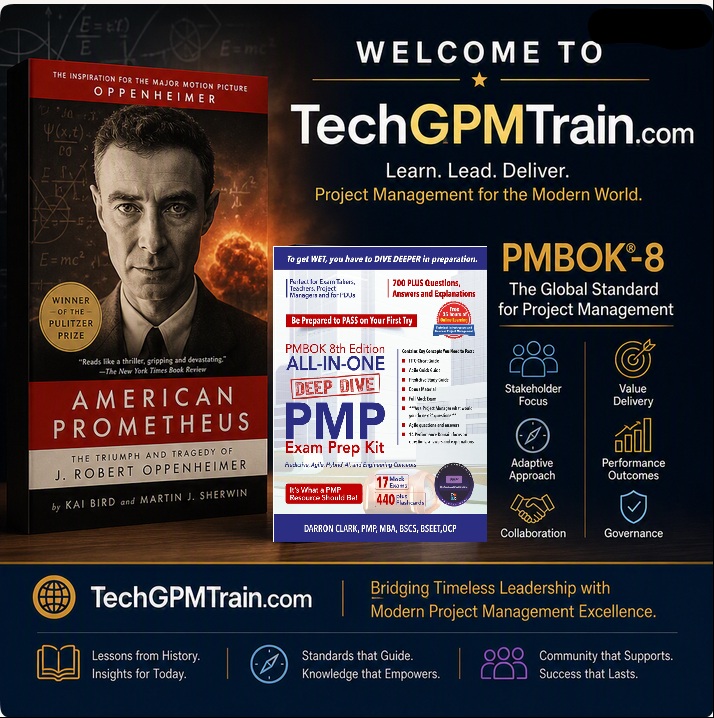
How American Prometheus Quietly Teaches Project Managers More Than Most PM Textbooks
How American Prometheus Quietly Teaches Project Managers More Than Most PM Textbooks

If you read American Prometheus, you’re not just reading the story of J. Robert Oppenheimer — you’re reading the story of one of the most complex, high‑stakes projects ever attempted: the Manhattan Project. And buried inside that narrative are lessons every Project Manager should pay attention to.
Here’s what stood out to me from a PM perspective:
1. The Manhattan Project was the ultimate cross‑functional team
Oppenheimer wasn’t the smartest physicist in the room — he was the one who could bring the smartest physicists together. That’s the PM superpower.
He coordinated:
- theoretical physicists
- experimental physicists
- chemists
- metallurgists
- engineers
- military stakeholders
- political leadership
That’s not science — that’s stakeholder orchestration at a scale most PMs never imagine.

2. He mastered the PM art of “translating between worlds”
Oppenheimer could explain quantum mechanics to generals and military constraints to scientists. That’s the same skill modern PMs need when translating between:
- business → engineering
- executives → delivery teams
- constraints → creativity
- risk → action
A PM who can’t translate becomes a bottleneck. A PM who can translate becomes indispensable.
3. He built a project culture, not just a project plan
Los Alamos wasn’t just a facility — it was a culture of urgency, secrecy, innovation, and collaboration. Oppenheimer shaped that culture intentionally:
- He encouraged open scientific dialogue.
- He removed barriers between disciplines.
- He created psychological safety for ideas.
- He kept morale high under impossible pressure.
PMs often underestimate culture. But culture is the invisible Gantt chart that determines whether the visible one succeeds.
4. He understood that risk isn’t a spreadsheet — it’s a moral weight
The Manhattan Project wasn’t just technically risky. It was ethically risky.
Oppenheimer carried the burden of:
- stakeholder expectations
- geopolitical consequences
- scientific responsibility
- moral ambiguity
Modern PMs don’t deal with nuclear weapons, but we do deal with:
- AI ethics
- data privacy
- safety-critical systems
- environmental impact
The book reminds us that risk management is not just probability × impact — it’s responsibility × consequence.

5. He proved that delivery under pressure requires ruthless prioritization
The project had:
- impossible deadlines
- unclear requirements
- evolving constraints
- competing scientific theories
- limited resources
Oppenheimer’s approach was pure PMI:
- Identify the critical path
- Remove blockers aggressively
- Protect the team from external noise
- Make decisions fast
- Iterate toward feasibility
He didn’t chase perfection — he chased progress.
6. He showed the
After the war, Oppenheimer lost political backing. And once that happened, his influence evaporated.
Every PM eventually learns this lesson:
- Delivery matters
- But political capital matters more
If you don’t manage:
- executive alignment
- stakeholder expectations
- organizational politics
…your project success won’t protect you.
7. The book is a reminder that PMs often carry the emotional weight of the project
Oppenheimer’s guilt, exhaustion, and internal conflict weren’t side stories — they were part of the project’s cost.
PMs often absorb:
- team stress
- executive pressure
- stakeholder conflict
- delivery anxiety
The book is a reminder: Leading a project changes you. Sometimes in ways you don’t see until it’s over.
Final Thought
American Prometheus isn’t a project management book — but it might be one of the most important books a PM can read.
It shows that the core of project management isn’t tools or templates. It’s leadership, translation, prioritization, culture, ethics, and the ability to deliver under pressure when the stakes couldn’t be higher.
If you’re a PM, Oppenheimer’s story isn’t just history. It’s a mirror.
Access the full course:
Now available:
#ProjectManagement #Leadership #PMBOK8 #AmericanPrometheus #Oppenheimer #RiskManagement #StakeholderEngagement #CrossFunctionalTeams #TechGPMTrain #PMLeadership #EthicalLeadership #ManhattanProject


